
Factory
Inside the Onlywell Factory: From Raw Materials to Finished Products
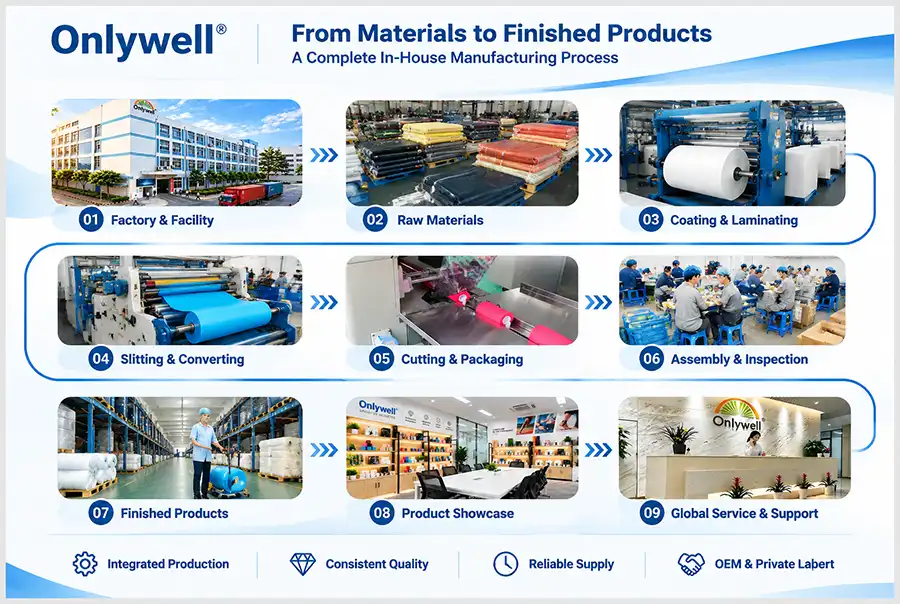
At Onlywell, manufacturing is more than a series of individual production operations. It is an integrated process that connects material preparation, fabric processing, coating and laminating, converting, cutting, packaging, assembly, inspection, and finished product management. This page takes you inside the Onlywell factory and introduces the nine key stages of our manufacturing operation, giving distributors, importers, sports medical brands, and business partners a clearer understanding of how our production facility works.
01. Factory & Facility: The Foundation of Our Manufacturing Operations
A reliable manufacturing process begins with an organized production environment. Onlywell's factory brings together the facilities, machinery, production areas, and operational resources required to manufacture sports tape and related products. Different production activities are arranged according to their functions, allowing materials and semi-finished products to move through the manufacturing workflow in an organized sequence.
02. Raw Materials: Starting with the Right Material Selection
The performance of sports tape begins long before the finished roll is produced. Material selection is one of the fundamental stages affecting the characteristics and suitability of the final product. Different applications require different material properties. Fabric structure, elasticity, tensile performance, softness, breathability, thickness, and surface characteristics can all influence how a tape performs during use. Depending on product specifications, the materials used in sports tape manufacturing may include cotton, rayon, nylon, elastic fibers, non-woven fabrics, and other supporting materials. For example, cotton, rayon, and nylon kinesiology tapes can offer different combinations of texture, elasticity, and wearing characteristics. Elastic materials such as spandex can contribute to the stretch and recovery properties required by particular product designs.
03. Coating & Laminating: An Important Manufacturing Stage
Coating and laminating are important processes in the production of adhesive sports tapes. During coating, adhesive materials are applied to the designated fabric or substrate using specialized coating equipment. The coating process needs to be controlled according to the product's technical requirements, including the intended adhesive characteristics, coating coverage, and material compatibility. For products using pressure-sensitive adhesives, factors such as adhesive formulation, coating conditions, substrate characteristics, and subsequent processing can influence the final bonding performance.
04. Slitting & Converting: Preparing Materials for Different Product Sizes
After the relevant material-processing stages, large rolls of processed material move into slitting and converting operations. Slitting involves dividing wider rolls into narrower rolls according to the required product dimensions. This is an important step in preparing materials for different tape widths and subsequent production requirements. For sports tape and cohesive bandage manufacturing, common commercial widths may include 2.5 cm, 5 cm, 7.5 cm, and 10 cm, depending on the specific product and order specifications.
05. Cutting & Packaging: Transforming Materials into Market-Ready Products
Cutting and packaging bring the manufacturing process closer to the finished product stage. Once materials have completed the necessary processing and converting operations, they are prepared for cutting, roll preparation, and packaging according to the relevant product specifications. The cutting process determines the required product dimensions and prepares materials for the next production operations. Depending on the product design, this may involve cutting materials into specified lengths or preparing individual components for assembly. Packaging is equally important because it protects the product, communicates essential product information, and supports storage, transportation, and distribution.
06. Assembly & Inspection: Combining Production with Quality Checks
Assembly and inspection are important parts of the manufacturing workflow, particularly for products that involve multiple components or additional manual operations. At this stage, production personnel carry out the required assembly, product handling, finishing, and inspection activities according to the relevant product requirements. The assembly process helps ensure that individual product components are properly prepared and that finished items meet their intended construction and presentation requirements. Inspection activities provide another opportunity to identify visible defects, packaging issues, dimensional deviations, or other inconsistencies that may require attention.
Depending on the product and inspection requirements, relevant checkpoints may include:
-
Appearance and surface condition
-
Product dimensions and specifications
-
Roll consistency and winding condition
-
Packaging integrity and labeling
-
Order-specific product requirements
Quality management is not limited to the final inspection stage. It is important to consider product requirements throughout the manufacturing workflow, from incoming materials to processing and finished goods. At Onlywell, assembly and inspection contribute to the coordination of production activities and the evaluation of finished products before they move into the warehouse stage. For business customers, an organized inspection process helps provide greater visibility into how products are handled before delivery.
07. Finished Products: Organized Storage and Order Preparation
Manufacturing does not end when a product has been assembled or packaged. Finished product management is another important part of the overall factory operation. After the relevant production and inspection activities, finished products are transferred to designated storage areas for organization and subsequent order preparation. Proper warehouse management helps separate different product types, sizes, colors, and packaging specifications. It also supports the identification and preparation of products according to customer orders.
08. Product Showcase: Understanding Our Manufacturing Range
A manufacturing facility should demonstrate not only how products are made, but also the range of products and applications that its production system supports. Onlywell's product showcase provides an overview of our sports tape and sports medical product categories, helping visitors understand our manufacturing focus and product development direction.
Our product range includes:
-
Cohesive Bandages: Self-adherent bandages designed to stick to themselves without requiring conventional adhesive attachment to the skin.
-
Kinesiology Tape: Elastic therapeutic tapes available in different fabric constructions, including cotton, rayon, and nylon options.
-
Rigid Sports Tape: Non-elastic sports tapes used in applications requiring firm support and restriction of movement.
-
Zinc Oxide Tape: Adhesive sports tapes designed for applications requiring strong fixation.
-
Elastic Adhesive Bandages: Elastic adhesive products available in different material structures and specifications.
-
Sports Recovery Products: Products developed for sports-related support and recovery applications.
Different products require different material combinations, manufacturing processes, and finished specifications. Our product showcase allows distributors, importers, and private label customers to explore available product categories and identify potential opportunities for cooperation. For customers with specific requirements, product discussions can cover material selection, dimensions, colors, packaging formats, and other relevant specifications.
09. Global Service & Support: Connecting Factory Production with International Customers
A manufacturing facility creates value when its production capabilities can be effectively connected with customer requirements. Onlywell works with international business partners, including distributors, importers, sports medical suppliers, and private label brands. Our global service and support activities are designed to connect customer communication with product specifications, manufacturing coordination, and order preparation. For customers developing their own product lines, OEM and private label cooperation may involve discussions about product construction, material options, dimensions, colors, packaging artwork, labeling, and other customization requirements.
An Integrated Manufacturing Workflow from Start to Finish
The nine stages shown in our factory production overview represent how different manufacturing activities are connected at Onlywell. Rather than viewing each operation as an isolated task, we consider the entire workflow as an interconnected production system. Raw materials provide the foundation. Coating and laminating prepare the materials for further processing. Slitting and converting establish the required dimensions. Cutting, packaging, assembly, and inspection bring the products closer to completion. Finished goods management then connects manufacturing output with customer orders and delivery preparation. This integrated approach helps us coordinate production activities, manage product specifications, and support a range of sports tape manufacturing requirements.
Why Manufacturing Process Visibility Matters to Our Partners
Choosing a manufacturing partner involves more than comparing product prices or reviewing samples. International buyers also need to understand how a factory organizes its production, manages different processing stages, and coordinates orders with varying requirements.
A transparent manufacturing overview helps customers evaluate several important considerations:
1. Production Process: Understanding the stages involved in manufacturing provides a clearer picture of how raw materials become finished products.
2. Material Preparation: Knowing that material selection and preparation are part of the workflow helps buyers understand the importance of product-specific requirements.
3. Processing Capabilities: Seeing coating, laminating, slitting, converting, cutting, and packaging operations helps explain the different manufacturing activities involved.
4. Quality Management: Understanding where assembly and inspection take place provides insight into the factory's approach to product consistency.
5. Order Coordination: Finished product storage and global service operations connect manufacturing activities with international business requirements.
These considerations are relevant to distributors, wholesalers, sports medical suppliers, and brands looking for a long-term manufacturing relationship.
Work with Onlywell
From raw material preparation to finished product management, Onlywell brings together multiple manufacturing stages within one coordinated production environment. Whether you are sourcing cohesive bandages, kinesiology tapes, rigid sports tapes, zinc oxide tapes, or other sports medical products, our team welcomes the opportunity to discuss your product requirements. For distributors and importers, we can discuss existing product specifications and supply requirements. For private label brands, we can explore OEM customization options, including product specifications, colors, sizes, and packaging requirements.
If you are looking for a manufacturing partner for your sports tape or sports medical product business, contact Onlywell to discuss your project.
Onlywell — From Materials to Finished Products.
Contact our team to discuss your OEM and private label requirements